Paid at the counter.Closed on the spot.
An invoice that can take the money — and closes itself when the money actually arrives. This page sets out how it works, who is who in law, and what it costs. No small print.
01
How it works
One link.Three ways to pay.
You issue the invoice as usual. Ksefly attaches a payment link that takes cards, Apple Pay and BLIK, and the same QR code prints on the invoice PDF — so your customer pays from a phone, an email or a printout. At the counter you can instead ask for a BLIK code and type it in with the amount on screen.
You don’t mark it paid.It marks itself.
When the money settles at Stripe, the invoice closes as paid on the server and returns to every device you own. Ksefly never stamps it in advance — the confirmation follows the money, not a declaration.
Before the first złoty arrives
- You connect your company in Ksefly, then open a Stripe account for it — a separate one per company.
- You give your identity documents, business details and bank account directly to Stripe, on Stripe’s own pages. Ksefly does not fill that form in for you.
- Only once that onboarding completes can an invoice take a payment.
Collection rules
- An invoice can be collected exactly once — a second attempt is refused.
- An invoice superseded by a correction stops being payable and its link expires.
- Split-payment (MPP) invoices never go on the card rails — those methods cannot settle under the split-payment mechanism.
- A link lives 24 hours and closes itself once it stops being current.
02
Who is who
The money goes to you.Not through us.
This is the most load-bearing paragraph on the page. You — your company — are the merchant of record, through your own Stripe account linked to your company in Ksefly. Stripe is the payment service provider, under an agreement you enter into directly with Stripe Payments Europe, Limited (Dublin, Ireland) during its onboarding.
Ksefly supplies software only. We never receive, hold or transmit the payer’s funds — the money goes straight from the payer’s card to the Stripe account connected to your business.
Payments are powered by 
We never seecard data.
The card is read and transmitted to Stripe by Stripe’s own component running on your device. What we store on our servers is Stripe’s identifiers, the amount, the currency, the status, the payment-method type, and the card brand and last four digits.
The full account — who contracts with whom, what Stripe decides, and what is yours to answer for — is in § 9 of the terms.
03
Commission
One rate.No small print.
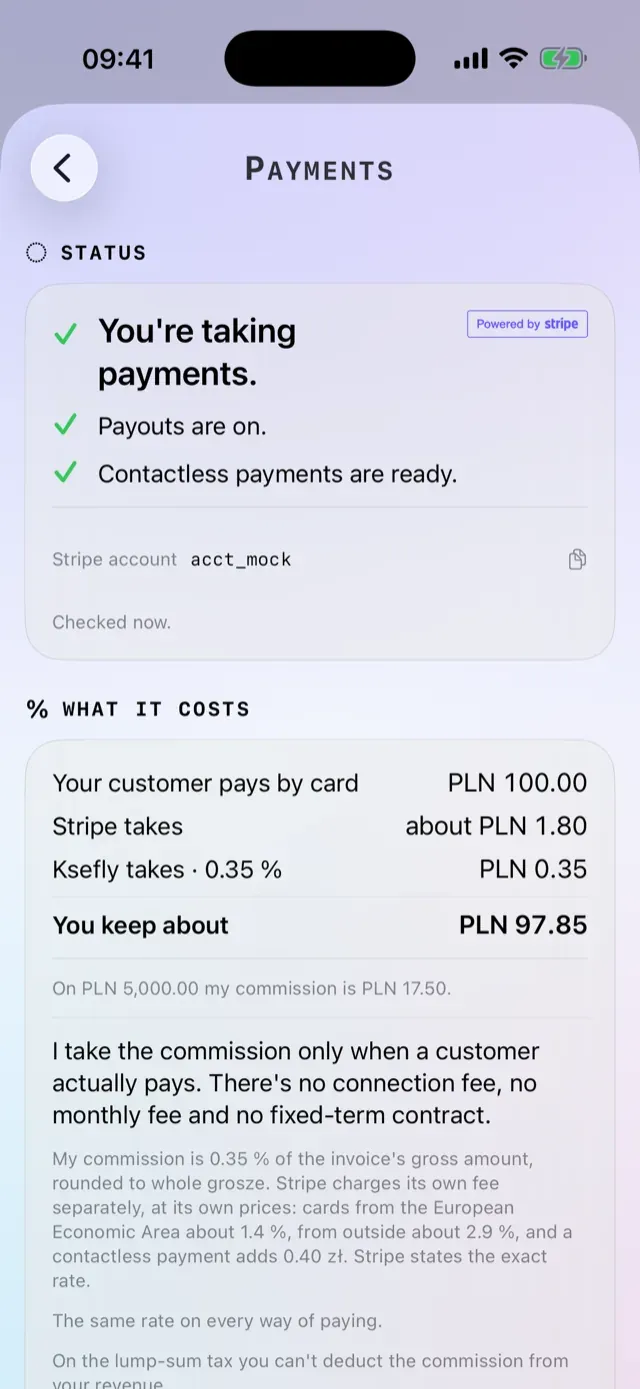
On every successful payment taken through Ksefly we charge a commission: 1.00% on Free, 0.35% on Ksefly Pro and 0.20% on Ksefly Ultra. It is calculated on the gross amount of the transaction — the same base comparable payment services use. The stated rate is a gross figure, VAT included: Stripe deducts exactly that percentage and nothing is added on top.
Stripe’s own fees are separate from our commission. They are charged to your Stripe account under your agreement with Stripe; we neither set nor collect them. Stripe publishes its current rates for Poland in its own pricing.
A worked example: you take 100.00 zł
- On Free our commission is 1.00 zł.
- On Ksefly Pro — 0.35 zł.
- On Ksefly Ultra — 0.20 zł.
- Stripe’s own fee is charged on top, per its pricing.
- Stripe credits the rest to your Stripe balance.
The commissioncomes with an invoice.
Stripe deducts the commission from your payment when it settles. For the commissions taken we issue — through KSeF — a collective monthly VAT invoice. You will find it in the app, beside the payments room, and you can have it delivered by email. On Pro you can tighten the cycle to a fortnight; on Ultra to a fortnight or a week.
In one line: Stripe’s own rate plus 1.00% on Free, 0.35% on Pro, or 0.20% on Ultra. The rules in full — § 10 of the terms.